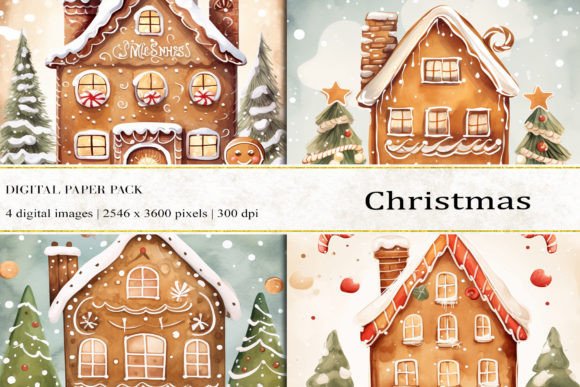
Christmas Ginderbread Digital Papers: A Practical Guide for Creative Projects
In the world of digital crafting and design, finding a texture that balances festive charm with professional quality can be challenging. Christmas Ginderbread Digital Papers offers a unique solution by combining the nostalgic warmth of holiday baking with high-resolution digital utility. This collection is not merely a set of images; it represents a specific aesthetic approach to seasonal design, utilizing advanced generative art technology to create backgrounds, textures, and textural elements that feel organic yet precise.
For adults aged 20 to 50 who are actively evaluating resources for scrapbooking, web design, or print projects, understanding the nuances of this format is essential. The set includes four distinct papers, each rendered at 2546 × 3600 pixels in JPG format at 300 dpi. These specifications ensure that whether you are printing a large-scale invitation or creating a small planner sticker, the visual fidelity remains intact. However, before integrating these files into your workflow, it is important to understand what makes them distinct from standard stock photography or traditional scanned paper textures.
Understanding the Distinctive Nature of Christmas Ginderbread Textures
The primary differentiator of Christmas Ginderbread Digital Papers lies in its origin and composition. Unlike traditional digital papers created by scanning physical materials, which often carry imperfections like dust, uneven lighting, or fiber irregularities, these images were generated using Midjourney, a leading generative art AI program. This technological foundation allows for a level of control over the "gingerbread" aesthetic that manual creation cannot always achieve.
When you examine the Christmas Ginderbread Background options within this set, you will notice a deliberate consistency in the visual language. The textures simulate the look of baked dough, icing swirls, and sprinkles without the mess associated with actual food photography. This makes them particularly valuable for designers who need a cohesive theme across multiple assets. For instance, if you are designing a series of invitations, you want the background to suggest the holiday spirit without distracting from the typography or personal details.
The resolution of 300 dpi is a critical factor here. In the industry, this is the gold standard for print production. It means that when you use these Christmas Ginderbread Textures for physical items like fabric printing or business cards, the edges remain crisp, and the fine details of the gingerbread patterns do not pixelate. This is a significant advantage over many free online resources that are optimized only for screen viewing (72 dpi) and fail when scaled up for print.
Evaluating Versatility Across Different Media
One of the most compelling arguments for choosing this specific set is its adaptability. The versatility of Christmas Ginderbread Digital Papers extends far beyond simple decoration. Because the images are high-quality JPGs, they integrate seamlessly into various software ecosystems, from Adobe Photoshop and Illustrator to Canva and Procreate.
- Planner Stickers and Stationery: The 2546 × 3600 pixel dimensions provide ample room for cutting out shapes or creating intricate planner layouts. The texture adds depth to digital planners, making them feel more tactile when viewed on tablets or printed for personal organization.
- Web Design and Graphics: For web graphics, the ability to scale these images down without losing detail ensures that buttons, banners, and email headers look professional. The warm tones of the gingerbread theme can soften the typically sterile look of corporate holiday emails.
- Home Decor and Fabric Printing: When used for home decor items, the high DPI ensures that large prints, such as canvas wall art or custom wrapping paper, appear smooth. Similarly, for fabric printing, the texture translates well to textiles, allowing crafters to create holiday-themed pillows or aprons with consistent coloring.
This range of applications demonstrates why the set is considered a robust resource. It avoids the limitation of being "good for one thing." Instead, it serves as a foundational element for a broader creative strategy.
Comparing Generative Art to Traditional Digital Paper Sources
When researchers and crafters evaluate their options, they often weigh the pros and cons of AI-generated content against human-made illustrations or photographed textures. Christmas Ginderbread Digital Papers sits at the intersection of these categories, offering a hybrid approach.
Traditional digital papers often rely on hand-drawn vectors or scanned watercolors. While these offer a charming, artisanal feel, they can sometimes lack the complex layering found in photorealistic textures. On the other hand, stock photography of actual gingerbread cookies often suffers from inconsistent lighting, shadows that obscure details, or a lack of variety in the pattern repetition.
The advantage of the Christmas Ginderbread Background set generated by AI is the ability to create seamless, repeatable patterns that maintain a uniform color palette. This is particularly useful for collages and scrapbook albums where multiple pages must share a cohesive visual identity. You do not have to worry about mismatched colors between different sheets because the generative process ensures a unified style across all four papers in the set.
However, there are tradeoffs to consider. Purists who prefer the imperfection of human touch might find the perfection of AI generation slightly too clean. Additionally, while the images are high resolution, they are raster-based (JPG). If a project requires infinite scalability or vector manipulation (like resizing a logo without quality loss), these files would need to be traced or converted, whereas vector-based digital papers would be superior. For most users, however, the 300 dpi JPG format is sufficient and widely compatible.
Decision Factors: When to Choose This Set
Selecting the right digital asset depends heavily on the specific requirements of your project. Here is a breakdown of scenarios where Christmas Ginderbread Digital Papers is the optimal choice versus when you might need an alternative.
Choose this set if:
- You require print-ready quality (300 dpi) for physical products like greeting cards, invitations, or fabric.
- Your project demands a specific, cohesive color story that spans multiple documents or pages.
- You need textures that evoke a specific mood (warm, rustic, sweet) without the logistical challenges of sourcing real props.
- You are working on a tight deadline and need instant access to high-quality, ready-to-use backgrounds.
Consider alternatives if:
- Your project requires vector graphics for logos or icons that need to be resized frequently.
- You are looking for a hand-painted or sketchy aesthetic rather than a photorealistic or semi-realistic texture.
- You need fully editable layers (e.g., separate layers for icing, cookie, and background) within a PSD file, as this set is provided as flat JPGs.
It is also worth noting the ethical and practical considerations of using AI-generated art. For commercial projects, it is crucial to review the licensing terms associated with the specific platform or creator. Generally, high-quality digital paper sets come with clear usage rights for both personal and commercial endeavors, but verifying this ensures peace of mind.
Maximizing the Potential of Your Resources
To get the most out of this collection, users should treat the four papers as complementary tools rather than isolated assets. The strength of the set lies in its ability to mix and match. For example, you might use one Christmas Ginderbread Texture as a base layer for a photo album cover, overlaying another texture to add depth to the corners. This layering technique mimics the complexity of real-world crafts while maintaining digital efficiency.
Furthermore, the neutral yet thematic nature of the gingerbread motif makes it a safe choice for a wide demographic. Unlike designs that feature specific characters or overly stylized fonts, these textures focus on the material itself. This neutrality allows them to support a vast array of typographic choices, from elegant calligraphy for wedding-style invitations to bold, modern sans-serifs for party flyers.
Ultimately, the decision to invest in Christmas Ginderbread Digital Papers comes down to the balance between quality, versatility, and efficiency. By providing high-resolution, professionally themed backgrounds, this set eliminates the need for time-consuming background creation or searching for disparate clipart. It streamlines the creative process, allowing designers and crafters to focus on the core message of their project—whether that is celebrating the holidays, organizing their year, or simply expressing creativity.
Whether you are a seasoned graphic designer building a portfolio or a hobbyist preparing gifts for loved ones, having a reliable source of high-quality textures is invaluable. The combination of advanced generation technology and practical application specs makes this set a strong contender in the market for seasonal digital resources. As you move forward with your planning, keep in mind that the best tool is the one that fits your specific workflow and aesthetic goals perfectly.